
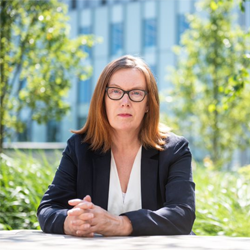
Professor Gilbert joined the Nuffield Department of Medicine at Oxford University in 1994 and became part of the Jenner Institute (within NDM) when it was founded in 2005. Her chief research interest is the development of viral vectored vaccines that work by inducing strong and protective T and B cell responses. She leads work on influenza vaccine development as well as vaccines for many different emerging pathogens, including Nipah virus, MERS, and Lassa virus.
Professor Gilbert’s work also focuses on the rapid transfer of vaccines into GMP manufacturing and first in human trials. This is achieved through collaboration with colleagues in the Clinical Biomanufacturing Facility and Centre for Clinical Vaccinology and Tropical Medicine, all situated on the Old Road Campus in Oxford.
In 2020 Professor Gilbert became the Oxford Project Leader for ChAdOx1 nCoV-19, a vaccine against the novel coronavirus SARS-CoV-2. This vaccine, tested by the University of Oxford in clinical trials of over 23,000 people in the UK, Brazil and South Africa, is now in use in many countries around the world in the fight against the Covid-19 Pandemic.
‘I have worked in the development of vaccines against infectious pathogens for many years and in the last 2 years have been able to draw on all that I have learned in order to respond to the SARS-CoV-2 pandemic. I have been so fortunate to work with a very talented and dedicated team who made it possible to develop a vaccine in less time than anyone thought possible.’
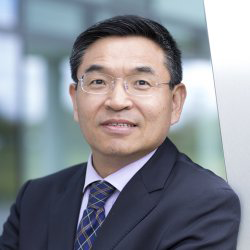
Professor G Q Max Lu
President and Vice-Chancellor,
University of Surrey
Professor Max Lu is President and Vice-Chancellor of the University of Surrey. He is a member of the Prime Minister’s Council for Science and Technology and a Director of the Board of National Physical Laboratory. He chairs the UK Forum for Responsible Research Metrics, served on the Board of Universities UK and until recently, the Board of UKRI. He is a Deputy Lieutenant of Surrey and a patron of the charities Transform and The Surrey Youth Focus.
Professor Lu founded the Australian Research Council’s Centre of Excellence for Functional Nanomaterials and served as its director for eight years. A pre-eminent chemical engineer and nanotechnologist, Professor Lu is a highly cited academic in Chemistry. He has published over 500 journal papers (h=128, and 66,800 citations). He is co-inventor of more than 20 granted international patents.
He was awarded the Medal of the Order (Officer) of Australia in 2017 for his distinguished service to education and international research. He was named as a Queensland Great in 2013 and one of Australia’s ‘Top 100 Most Influential Engineers’ several times.
Professor Lu has served on many government committees and advisory boards including those under the Australian Prime Minister’s Science, Engineering and Innovation Council (2004, 2005 and 2009), Australian Research Council College of Experts (2002–2004), Australian Synchrotron and Stem Cells Australia.
He is Fellow of Royal Academy of Engineering, Institution of Chemical Engineers, Australian Academy of Science, Australian Academy of Technology and Engineering, World Academy of Science, National Academy of Inventors, and a Foreign Fellow of the Chinese Academy of Sciences.
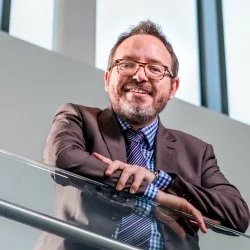
Professor Paul A. Townsend
Pro-Vice-Chancellor and Executive Dean of the Faculty of Health and Medical Sciences
Professor Paul Townsend is Pro-Vice-Chancellor and Executive Dean for the Faculty of Health and Medical Sciences. An internationally renowned scientist in the field of cell stress and survival mechanisms, Paul has a passion for teaching and mentoring both undergraduate and postgraduate students. He brings with him a wealth of industry and enterprise experience, having co-founded several companies and provided strategic advice to others in the sector. He is adjunct professor at A*STAR, Singapore, as well as Honorary Research Professor at the University of Athens.
Paul is a University of York graduate (1993) and obtained his PhD from the Imperial Cancer Research Fund (now CRUK) in 1997. He has researched cell survival mechanisms in a number of chronic diseases. He has undertaken research in Germany and the USA as well as the UK and became an academic independent group leader at the University of Southampton (2004-2013). He joined the University of Manchester in 2013 as the Associate Dean for Business Engagement Research professor in the Manchester Cancer Research Centre/ CRUK Manchester Institute.
Previously, he helped establish a graduate entry to Medicine UG programme and a number of Masters’ courses, in addition to successful research funding to large scale infrastructure of £12.8M Stoller from the MRC as Co-I, and £28.5M BRC from NIHR as Co-I. He presents frequently at UK and international conferences as well as contributing to UKRI committees, international agencies such as WeHi and Peter Mac in Australia, NIH in the US, Hong Kong, Pasteur Institute in France, HRB in Ireland and co-chairs the Clinical and Sciences Committee of the FCT in Portugal.
He has research strengths in drug discovery, validation, cell stress and survival mechanisms, senescence, DNA damage, and the use of AI and multiple ‘omics in cancer, bone cell and cardiac biology, and apoptosis regulation. Recently, he has explored senescence and licensed the technology he invented along with using advanced mass spectrometry in identifying novel biomarkers and regulators of cellular homeostasis. Paul is also the cofounder of Karus Therapeutics now based in Oxford, raised >$120M, Pentagon Therapeutics and PRECignature whilst also advising a number of other companies as a consultant and Non-Executive Director.
Overall, Paul’s academic-enterprising health and wellness research, linking to social and engineering sciences, knowledge exchange and partnership generation acumen and experience is internationally recognised; he conducts teaching and research to a consistently high level, generating significant levels of funding and outputs, is passionate about his UG/PG teaching and mentorship and interacts exceptionally with all stakeholders including industry – generating IP, guiding colleagues and students in their research, teaching and enterprise activities, as well as working intimately with the NHS, NIHR, NHS England and the community via many outreach activities.